Fraud Prevention · Reviewed October 12, 2026
Bank Impersonation Scams in 2026: What to Do When a “Fraud Department” Calls
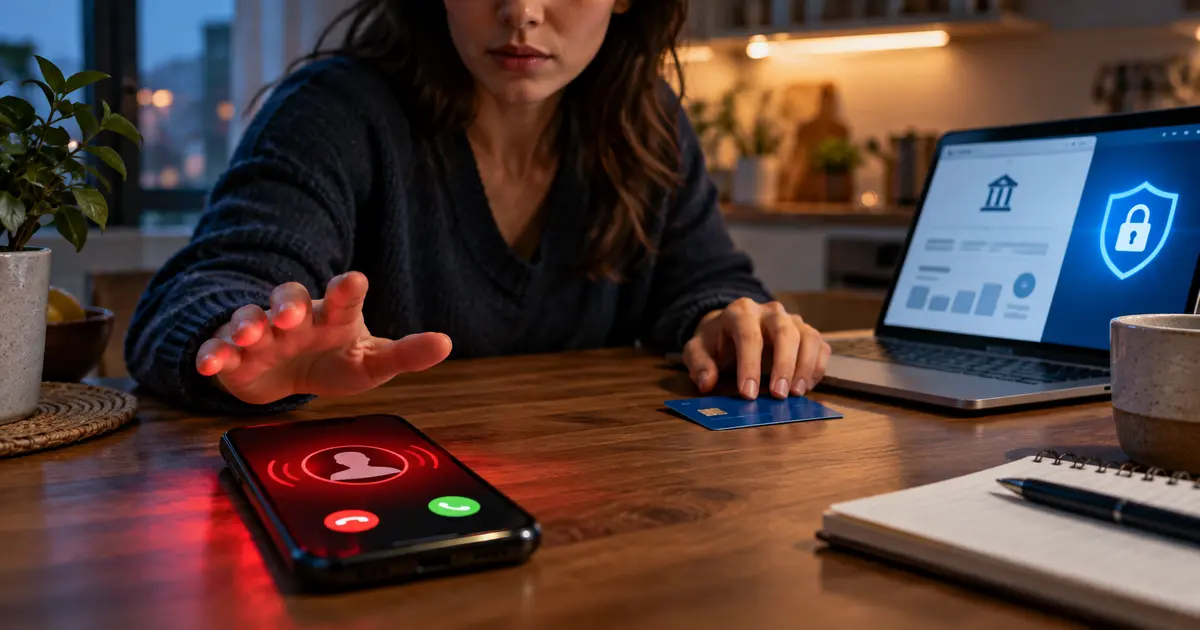
Answer first: If someone claiming to be your bank says you must move money to “protect it,” stop. Do not transfer funds, share a one-time code or install remote-access software. Hang up, wait a moment, and call the number printed on your bank card or statement. Caller ID, account details and an urgent fraud story can all be faked.
Why this scam deserves attention in 2026
The Federal Trade Commission reported in June 2026 that consumers reported $3.5 billion in losses to imposter scams during 2025, nearly 20% more than the prior year. The FTC says some of the costliest cases begin with a fake security alert that appears to come from a bank. In September 2026, the agency also sought public comment on updating its impersonation rule to address how digital platforms can promote impersonation scams.
Reported losses are not a complete measure of all fraud, and the $3.5 billion figure covers many kinds of impersonators—not only fake banks. It does show why a convincing “fraud department” call should be treated as a verification problem, not an instruction to act quickly.
The scam works because it borrows real fraud-prevention language. The caller may know your name, bank, partial card number, address or a recent transaction. That information may come from a data breach, phishing message, stolen mail or public record. Knowledge is not authentication.
The anatomy of a fake bank call
- Trigger: You receive a text, email or call about a suspicious purchase, login or transfer.
- Authority: A caller claims to be a bank investigator, government agent or technical specialist.
- Fear: They say your account is under attack, your identity is tied to a crime or your money will disappear.
- Isolation: They tell you not to call the branch, talk to family or mention the “investigation.”
- Action: They instruct you to transfer money, buy crypto, withdraw cash, use a payment app or read a security code.
- Continuation: After one payment, they invent taxes, verification fees or additional compromised accounts.
The core promise is false: there is no special government vault or safe account that requires you to move your own funds. The FTC's plain rule is useful—someone who tells you to move money to protect it is a scammer.
Seven warning signs you can recognize quickly
1. Urgency that prevents independent verification
A legitimate fraud team may ask whether you recognize a transaction, but you can end the call and contact the bank yourself. A scammer needs you to remain inside the conversation.
2. A request for a one-time passcode
That code may approve a transfer, add a digital wallet, reset a password or enroll a new device. Read the full code message. Banks commonly warn that employees will not ask for it.
3. Instructions to move money
A transfer to a “safe,” “secure” or “government protected” account is the defining red flag. The destination belongs to the criminal or a money mule.
4. Unusual payment rails
Scammers favor bank transfers, wire transfers, cryptocurrency, payment apps, cash and gift cards because reversal can be difficult. The FTC reported that people lost more than $4 billion in 2025 to scams paid through bank transfers and cryptocurrency combined.
5. Caller-ID proof
A phone screen can display a bank's real name or number even when the call came from somewhere else. Do not call back from the recent-call list. Type the official number yourself.
6. Remote access or screen sharing
No bank needs control of your computer to reverse fraud. Remote access can expose passwords, balances and verification codes or let the scammer move funds while hiding the screen.
7. Secrecy
Claims that a teller, relative or local police officer is “in on it” are designed to cut off people who would challenge the story. Stop and tell someone you trust.
What to do during the call
Do not debate the caller or disclose additional facts. Say you will contact the bank directly and hang up. If the caller threatens arrest or immediate account closure, hang up anyway. Legitimate institutions provide a path to verify through official channels.
Use the number on the back of your physical card, a recent statement or the bank's verified website. If you received a suspicious text, do not tap its link. Open the banking app independently and check notifications. Ask the real bank whether the alert exists and whether any new payee, device, password reset or transfer appears.
If the caller claimed a card charge was fraudulent, a real bank can close the card and issue a replacement without asking you to send money elsewhere. If the concern is an account takeover, the bank can restrict the account through its own systems.
If you already transferred money: act in this order
1. Contact the payment provider immediately
Tell the bank, wire service, payment app or crypto platform that the payment was induced by fraud. Ask for the fraud department and request a recall, reversal, recipient freeze or beneficiary-bank notification. Use accurate language: explain that an impersonator deceived you. Do not wait for a police report before making the first call.
2. Secure the accounts the scammer touched
From a clean device, change the bank and primary email passwords. Sign out other sessions, remove unknown devices, reset security questions and enable multifactor authentication. If remote-access software was installed, disconnect the device from the internet and obtain reputable technical help before using it for financial logins.
3. Preserve evidence
Save screenshots, phone numbers, usernames, wallet addresses, transfer confirmations, emails and chat logs. Write a timeline while details are fresh. Do not delete the conversation until the bank and investigators say it is no longer needed.
4. Report the fraud
File at ReportFraud.ftc.gov. If personal information was exposed, use IdentityTheft.gov for a recovery plan. Large, ongoing or local losses may also warrant a police report and an FBI Internet Crime Complaint Center report.
5. Watch for a second scam
Fraud victims are often targeted again by people promising recovery for an upfront fee. A stranger cannot guarantee the return of a wire or crypto payment. Do not give a “recovery specialist” account access, more money or identity documents.
Bank transfer, wire, payment app and crypto: recovery differs
A bank transfer through ACH may have a different dispute process from a domestic wire. A payment-app transfer may be treated differently depending on whether the account was hacked or you were deceived into authorizing it. Cryptocurrency transactions are usually irreversible at the blockchain level, but a centralized exchange may be able to freeze assets that remain on its platform. This is why immediate reporting matters.
Do not assume that every scam payment is automatically reimbursed. Consumer protections can depend on how the transaction occurred, how quickly it was reported and whether credentials were stolen or the consumer authorized the payment. Ask the bank for a written explanation of its decision and the specific appeal process.
Protect the rest of your financial life
If the scammer obtained a Social Security number, driver's license or enough information to open accounts, consider credit freezes at Equifax, Experian and TransUnion. A freeze is free and does not affect your credit score. Our credit freeze vs. fraud alert guide explains the difference and provides a bureau-by-bureau checklist.
Review recent bank and card transactions. Change reused passwords everywhere, starting with email and phone-carrier accounts. Set transaction, login and profile-change alerts. Ask the mobile carrier for an account PIN to reduce SIM-swap risk.
If the call concerned an investment account, contact the brokerage directly and read our SIPC vs. FDIC guide. SIPC and FDIC protections should not be confused with recovery from a transfer you authorized to a scammer.
A family anti-scam protocol
Create a rule that no household member moves money because of an incoming call or message. Require a pause and a second person for any unexpected transfer above a chosen amount. Agree on a family verification phrase that is not posted online, especially as voice-cloning scams improve.
Keep official bank and card numbers in a secure contact list. Review common scripts with older relatives without taking away their autonomy. The goal is to make pausing normal, not embarrassing. A scammer's advantage disappears when the target hangs up and verifies independently.
Before sending any urgent payment
- Did the request begin with an incoming call, text, email or social message?
- Is someone telling you not to talk to another person?
- Are you being asked for a code, remote access or a new transfer recipient?
- Does the payment use wire, crypto, a payment app, cash or gift cards?
- Have you called the institution using a number you independently verified?
If any answer raises concern, stop. No legitimate fraud investigation becomes safer because you act before checking.
Official sources
- FTC: $3.5 Billion in Reported Imposter-Scam Losses in 2025
- FTC: Never Move Your Money to “Protect It”
- FTC: How Payment Instructions Reveal Scams
- FTC: September 2026 Impersonation Rule Review
Frequently asked questions
Bank Impersonation Scam FAQs
No legitimate bank, the FTC or another government agency will require you to move money to a “safe” account, buy cryptocurrency, use a payment app or share a verification code to protect your funds.
Disclaimer
This article is general fraud-prevention education, not legal advice or a guarantee of recovery. Policies and legal rights depend on the transaction and institution. Contact the involved financial institution and appropriate authorities promptly.