Refinance Break-Even Calculator Guide: When Does Refinancing Actually Make Sense?
Refinancing a mortgage sounds simple: get a lower rate, save money. But there's a catch. Every refinance costs money upfront-appraisal, origination fees, title work, recording, underwriting. Those closing costs can run $3,000 to $18,000, depending on your loan size. The question isn't "Is the rate lower?" It's "Are my monthly savings enough to justify the upfront costs-and do I stay in the home long enough to collect those savings?" That's where the break-even point comes in. It's a single number that decides whether refinancing makes sense or wastes your money.
The Break-Even Formula
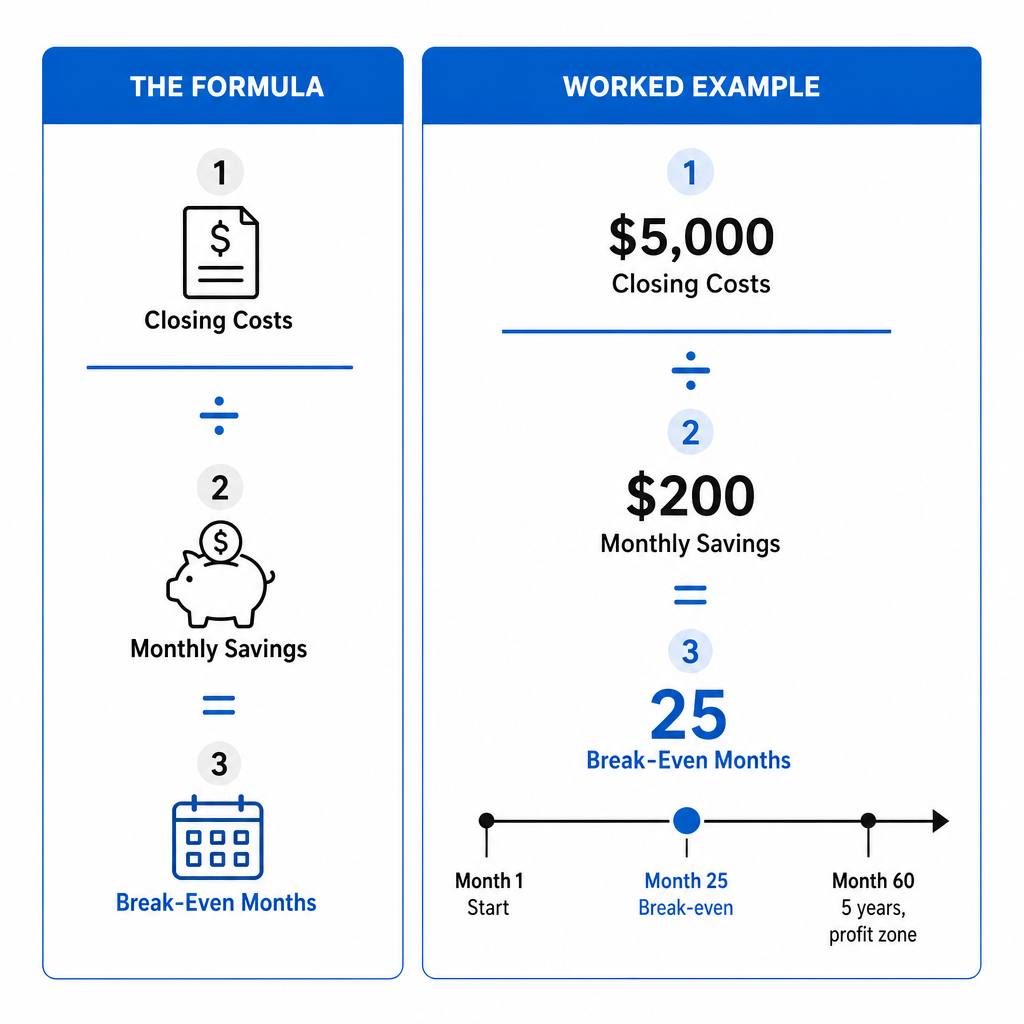
Break-even point (months) = Total closing costs ÷ Monthly payment savings. Divide your closing costs by how much your payment drops each month, and you get the number of months until refinancing "pays for itself."
The break-even formula: one line that matters
That's it. After the break-even point, every dollar of savings is profit. Before that point, the refinance is still recovering its upfront cost.
Worked example
- Your closing costs: $5,000
- Your monthly payment savings: $200
- Break-even: $5,000 ÷ $200 = 25 months (just over 2 years)
If you stay in the home for 5 years, you collect 3 extra years of savings-roughly $7,200 in profit. If you move in 1.5 years, refinancing costs you about $2,000.
Real homeowner scenarios: when break-even math wins or loses
Breaking the formula down is one thing. Seeing how it plays out in real decisions is another.
Scenario 1: Locked high in 2023, ready to move
Consider a hypothetical $300,000 remaining balance at 7.0%. If a qualified borrower receives a 6.1% refinance quote with the same remaining term, the principal-and-interest payment would fall—but the decision still depends on points, lender fees, taxes, insurance and how long the borrower keeps the loan. Enter the actual Loan Estimate figures instead of treating this illustration as a current market quote.
With typical closing costs of 3% (about $9,000), the break-even is: $9,000 ÷ $149 = 60 months (5 years).
The decision: If they're staying 7+ years, refinancing saves them real money-likely $10,000+. If they might move in 4 years, it's marginal. If they're job hunting and might leave in 2 years, skip it.
Scenario 2: Rate drop with short break-even
Refinancing from 6.875% to 5.75% on a $250,000 mortgage. The payment drops from $1,656 to $1,457-a $199/month win. Closing costs: $4,000 (negotiated).
Break-even: $4,000 ÷ $199 = 20 months (less than 2 years).
The decision: This is a strong candidate. Even if life throws curveballs and you move in 3-4 years, you still profit.
Scenario 3: The trap-dropping your rate but extending your loan
You've paid for 10 years on a 30-year mortgage. Your balance is now $250,000 on what started as a $400,000 loan. You can refinance to a lower rate-6.0%-but here's the catch: the new loan would also be 30 years, resetting your payoff clock.
Monthly payment looks great: it drops by $1,299. But you've extended your payoff from 20 years to 30 years. You'll pay significantly more in total interest, even though the monthly payment feels like a win.
The decision: Refinance to match your remaining term (a 20-year loan, in this case), not a 30-year. Your payment won't drop as much, but your total cost stays on track.
Scenario 4: PMI removal-a hidden game-changer
A first-time homebuyer put 10% down and has been paying PMI ($250/month) for 3 years. Home values appreciated; they now have 15% equity. They can refinance to conventional financing and eliminate PMI entirely-a $250/month savings.
Closing costs: $3,000.
Break-even: $3,000 ÷ $250 = 12 months.
The decision: This is a no-brainer. Even a modest home appreciation that triggered refinance qualification is a fast payoff. PMI removal alone often justifies a refinance, rate drop or not.
Closing costs: the upfront bill you can negotiate
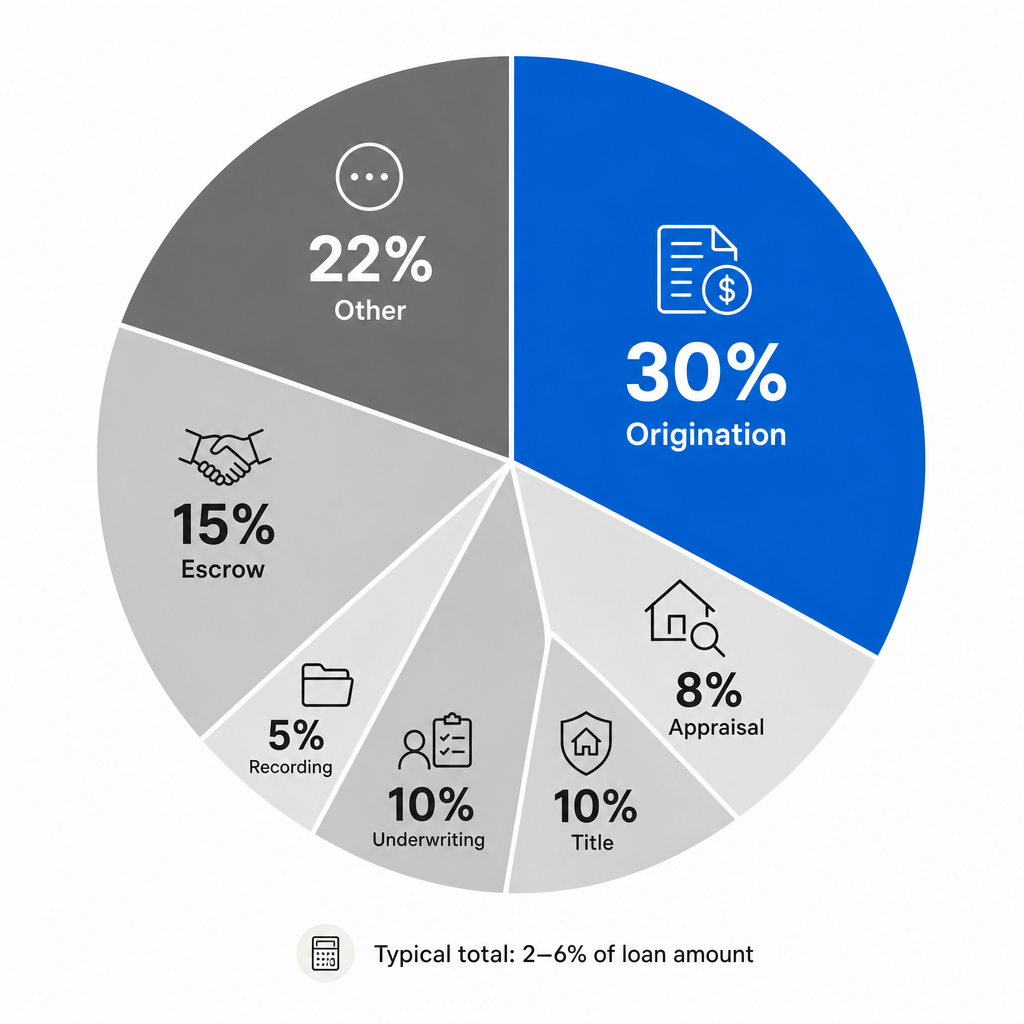
Closing costs are the first barrier to refinancing. Typical range: 2-6% of the loan amount. On a $300,000 loan, that's $6,000-$18,000. But these costs are itemized-and many are negotiable.
What you'll pay
- Origination fee: 0.5-1% of loan (lender's cut)
- Appraisal: $300-$600
- Title search and insurance: $500-$1,000
- Recording and transfer taxes: $100-$500+ (varies by state)
- Underwriting and processing: $500-$1,000
- Escrow/closing agent: $500-$1,500
Ways to lower closing costs
- Shop lenders. Your first lender won't be your best. Get quotes from 3-5 lenders; fees vary significantly.
- Negotiate origination fees. Tell the lender you have competing offers. Many will waive or reduce this fee to win your business.
- Ask for lender credits. Some lenders will absorb fees in exchange for a slightly higher rate. Sometimes this trade-off makes sense.
- Request an appraisal waiver. If your home hasn't dropped in value, many lenders waive appraisals on refinances, saving $500+.
- Reissue your title policy. If you bought recently, your existing title insurance can be reissued at a discount.
- Check for employer programs. Some employers negotiate discounts with lenders; check with your HR department.
- Roll costs into the loan. A "no-out-of-pocket" refinance means you pay interest on closing costs, but you don't bring cash to closing. Calculate the 30-year impact first.
- Time your closing. Closing early in the month costs less in daily interest charges than closing near month-end.
Negotiating hard can save $2,000-$4,000, which dramatically shortens your break-even point.
Time horizon: the real decision gate
The break-even formula is clean math. But the decision isn't mathematical-it's about your life. How long will you stay in the home?
- Staying 2-3 years: Break-even must be under 18 months. Any longer and you're gambling.
- Staying 5 years: Break-even up to 36 months is reasonable; you'll collect 2+ years of savings.
- Staying 10+ years: Break-even up to 60 months is acceptable; you'll collect 5+ years of savings.
- Unsure: Be conservative. If you can't confidently say you'll stay 5 years, make your break-even target under 24 months.
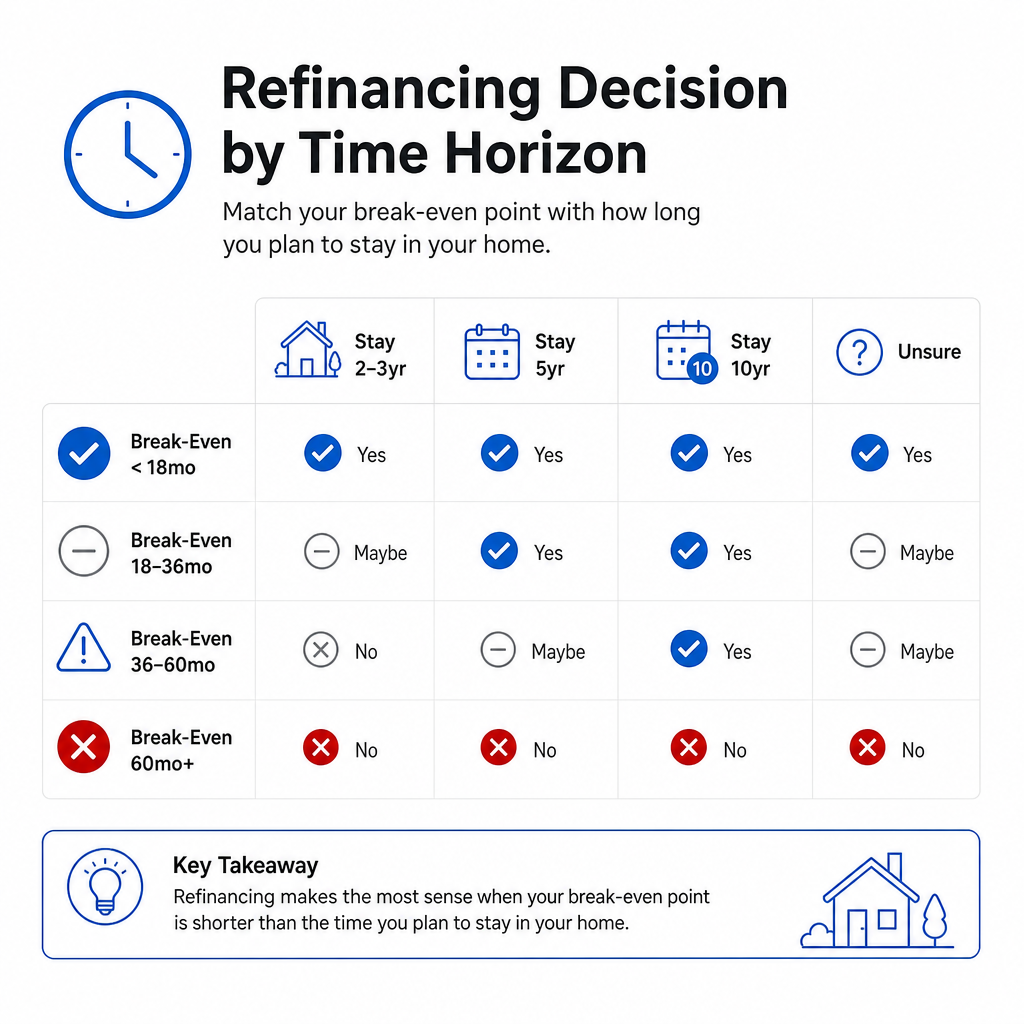
Life changes-jobs, family, health. Many homeowners thought they'd stay 10 years and moved in 4. Being conservative with your time horizon is usually smarter than gambling on a longer break-even point.
Cash-out refinance vs. HELOC: which tool for your goal?
If you need to access your home's equity-for renovations, debt payoff, or major expenses-refinancing isn't your only option. You can also use a HELOC (Home Equity Line of Credit).
Comparing your options
- Rate-and-term refinanceReplace your entire loan with better terms. Costs closing fees but locks in a fixed rate for 15 or 30 years.
- Cash-out refinanceTake out a larger loan and pocket the difference between old and new balance. Adds closing costs but gives immediate access to cash.
- HELOCA second line of credit secured by your home's equity, typically with lower fees and a variable rate.
When to use each
- HELOC wins if: You already have a low first-mortgage rate (under 5.5%) and want to avoid refinancing costs and rate resets. A HELOC preserves your existing rate.
- Cash-out refinance wins if: You need a large lump sum upfront AND you're okay with a higher overall loan balance and restarted amortization clock. Lock in a fixed rate for decades.
- Rate-and-term alone if: You just want to save on monthly payments without taking on new debt.
Use USFinNexus's refinance and HELOC calculators side-by-side to model each scenario and see which math wins for your situation.
The 2026 rate environment: where refinancing stands
30-year fixed rates are hovering around 6.36%, with 15-year rates at 5.71%. That's down from last year's peaks (6.81% / 5.92%), but still elevated compared to pandemic lows.
Freddie Mac's weekly PMMS average was 6.69% for a 30-year fixed mortgage on August 6, 2026. That national average is not a refinance quote and does not predict future rates. Use the rate, points and fees on your own Loan Estimate; even a lower note rate may not justify the transaction when costs or a term reset are included.
Don't wait for a perfect rate. The cost of waiting-staying at a higher rate for months-often exceeds the benefit of a slightly lower rate later.
Avoiding the big mistakes
Try USFinNexus
USFinNexus's refinance calculator does the break-even math for you instantly. Input your current loan, the new rate you're being offered, and your estimated closing costs. The calculator outputs your break-even date, monthly savings, and lifetime savings-all in seconds, with no email required and zero data collection.
No signup. No ads. No lender referral bias. Just the math. It works client-side (nothing leaves your browser), exports to a professional PDF in one click, and updates rates monthly from Freddie Mac's Primary Mortgage Market Survey.
Plug in your numbers and see if refinancing pencils out for your situation.

